
Information Design: Keep it Short and Simple (KISS)
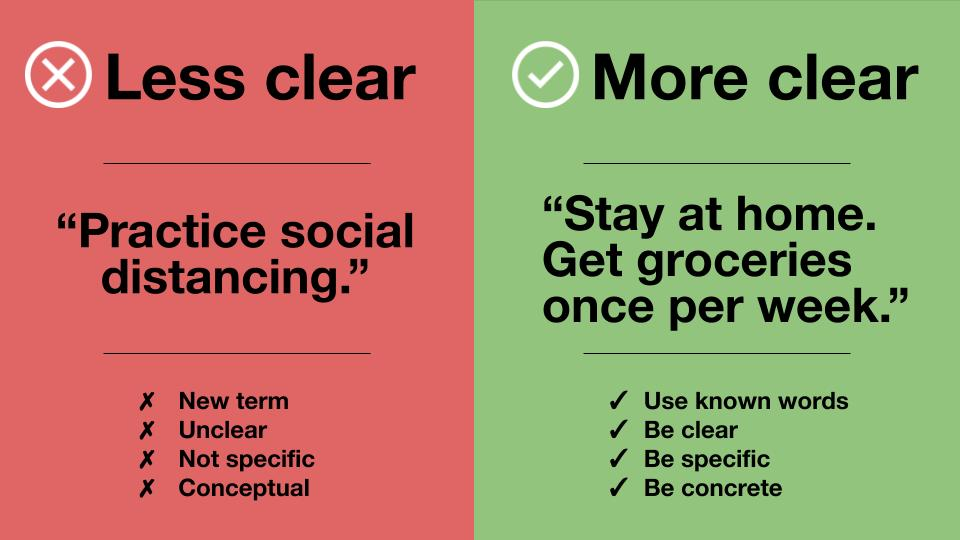
a) Calling people names is not helpful
b) Short and simple is better than just simple
Read on to learn why.
The Meaning of a Word
Let’s break it down. According to Merriam dictionary:
Social (adjective)
- relating to society or its organization
- needing companionship and therefore best suited to living in communities
- (noun) an informal social gathering, especially one organized by the members of a particular club or group
Distancing (verb)
make (someone or something) far off or remote in position or nature
If we use the terms together that could mean to get far away from society, far away from companionship, or far away from social gathering.
But that invites so many questions.
Like, how far away? Do I really need to be in the mountains, off-grid for it to count as remote?
And what constitutes a social gathering? One, two, three people? If I have four people in my immediate family living with me, does that constitute as a social gathering?
Thus, even if we look at the definition of the two words, it doesn’t actually explain what it means – and more importantly – why I should do it.
Which is why the CDC is started using the term physical distancing.
Why it Didn’t Work
Because we have 23 million Americans who have not graduated high school.
Because we have 44.7 million immigrants that are likely English as Second Language (ESL).
When trying to teach someone something, whether a class, infographic or directions, we have to think about why we are doing it.
If the purpose is to sound smart, then do that in your boardrooms and conferences. If the purpose is to help someone understand something, then KISS.
Keeping it Simple
Essentially you must explain-like-I’m-five (ELI5). If you want everyone to understand, you take it down to basic level and use terms that everyone can easily understand – even five-year-old children.
Take the information a part to the basic building blocks, then share what they need to know first for a basic foundation. From there, build on the knowledge you’ve given them (assuming they know nothing else).
Just like when we explain concepts and actions to small children, use language based on the fact they have never done it before. Children don’t have context to draw from or years of experience to know what you are talking about – and certainly not in your field, specialty, or organization – so no business jargon.
While you may be the expert on what you do, everyone else is like a five-year-old. So don’t be patronizing, but be a parent (or aunt).
Keeping it Short
Paragraphs:
Make it about four sentences. Provide relevant and related information. A new idea/concept is a new paragraph.
Sentences:
Keep at 12 words or less. Use active voice and direct language.
Bullet points/lists:
Super easy to scan. Be consistent with capitalizations, punctuations, and verbs.
Text Alignment:
Because people read left-to-right, left-aligned is easier for people to scan. Center text should be used sparingly, and right aligned should almost never happen.
Brevity Example
Lincoln’s Second Inaugural Address, one of the most effective speeches of all time, was
- 701 words long
- 505 words were one syllable
- 122 had two syllables
He was able to communicate the essence of a complex agenda without a big vocabulary or huge word count.
So KISS the next time you need to share an idea or information.
Similar Posts
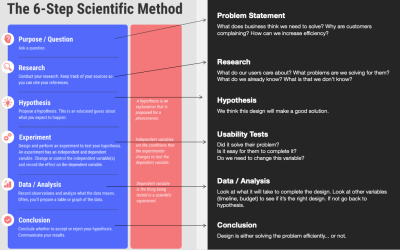
User Experience (UX) Process is Literally the Scientific Method
UX is a social science, so it makes sense that the UX process follows the scientific method.
When Customers Want ‘Faster Horses’ That Means We Need More User Research (Not Less)
When customers say they’d want ‘Faster Horses’, do more research, not less.
My Facebook Interviews
A recruiter from Facebook (Meta) reached out. I made it a few rounds, but not to the job offer.